Review Articles 
UDC: 005.915:640
336.6:640
DOI: 10.5937/menhottur2500017A
Measuring hotel financial performance: A bibliometric review
Alma Arnejo1, Melvin Sarsale1[*]
1 Southern Leyte State University, Philippines
Abstract
Purpose – This article presents a comprehensive review of hotel performance financial measurement achieved through bibliometric analysis. Methodology – Leveraging a successful sample of 982 articles from the Scopus database, this paper utilizes Bibliometrix and VOSviewer as suitable tools and selected techniques to pinpoint hot topics, core authors, top journals, and theoretical shifts in the literature. Findings – The results indicate a focus on revenue management, pricing, and forecasting. Big data and machine learning trends have begun to signify a shift in the way performance is evaluated in the hospitality industry. With the maturity of the field, gaps persist – especially in the limited access to hotel data and the lack of standardized financial metrics. Implications – This bibliometric review charts the field’s intellectual structure using performance analysis and science-mapping indicators, and identifies underexplored topics such as the link between profitability and pricing power, elasticity, ESG, and governance in the hotel industry. Anchored in the bibliometric evidence of this study, future researchers may explore new forecasting methods against profit-based metrics and adopt a wider range of empirical approaches.
Keywords: revenue management, profitability, hospitality industry, financial metrics
JEL classification: L83, M41, M21
Merenje finansijskih performansi hotela: Bibliometrijski pregled
Sažetak
Svrha – Ovaj članak predstavlja sveobuhvatan pregled merenja finansijskih performansi hotela postignut bibliometrijskom analizom. Metodologija – Na osnovu uzorka sačinjenog od 982 članka iz baze Scopus, u radu se koriste Bibliometrix i VOSviewer kao odgovarajući alati i izabrane tehnike kako bi se identifikovale aktuelne teme, ključni autori, vodeći časopisi i teorijski pomaci u literaturi. Rezultati – Nalazi ukazuju na fokus na upravljanje prihodima, formiranje cena i prognoziranje. Trendovi u oblasti velikih podataka i mašinskog učenja počeli su da ukazuju na pomak u načinu na koji se performanse procenjuju u ugostiteljskoj industriji. Sa zrelošću oblasti, i dalje postoje praznine – naročito u ograničenom pristupu hotelskim podacima i nedostatku standardizovanih finansijskih pokazatelja. Implikacije – Ovaj bibliometrijski pregled mapira intelektualnu strukturu oblasti koristeći pokazatelje analize performansi i naučnog mapiranja i identifikuje nedovoljno istražene teme kao što su veza između profitabilnosti i cenovne moći, elastičnosti, ESG-a i korporativnog upravljanja u hotelskoj industriji. Oslanjajući se na bibliometrijske dokaze ove studije, buduća istraživanja mogu da ispitaju nove metode prognoziranja u odnosu na profitno zasnovane metrike i da usvoje širi spektar empirijskih pristupa.
Klјučne reči: upravljanje prihodima, profitabilnost, ugostiteljska industrija, finansijski pokazatelji
JEL klasifikacija: L83, M41, M21
1. Introduction
The hospitality and tourism sector provides much value and is important in employment, investment, and tourism activities worldwide (Sharma et al., 2021; WTTC, 2023). One of the determining features of a firm’s financial success is its financial performance. This feature is impacted by internal and external factors such as operational efficiency, the business environment, and strategic planning (Duric & Potočnik Topler, 2021; Nguyen et al., 2023). In an era where competition within the hospitality sector intensifies, assessing financial performance has become paramount to firms looking to stay competitive in the dynamic market (Ashraf et al., 2023). Despite the highlighted importance of measuring financial performance in hotels, the literature indicates that there is still no agreement on effectively analysing it for hotels (Gibraltar et al., 2024; Yoopetch & Chareanporn, 2024).
Measuring hotel financial performance using RevPAR, GOPPAR, and ROI has already been studied (Herath et al., 2023; Olorunsola et al., 2024; Pons et al., 2025; Santoso & Supatmi, 2021). However, these studies take a partial approach by concentrating on a single indicator and neglecting a comprehensive understanding of the existing literature on financial performance measurement. In addition, bibliometric studies in this field are rare (Subying & Yoopetch, 2023). This situation limits the capacity to evaluate the growth of the research, identify critical publications, and identify new research directions. The problem reflects a deficit in the literature on systematic reviews that seek to synthesize data from different sources for hotels and their financial performance.
The performance metrics of hotel finances have become relevant internationally due to the impacts of global downturns and the COVID-19 pandemic (Ozdemir et al., 2021). In the context of hotel businesses, they face many financially intricate problems like evolving consumer tastes, changes in employment, and policy problems (Dutta, 2024). With these changing variables, consideration of the prevailing research gaps identifies the necessity for stakeholders within the industry, government, or academics to formulate implementable measures on financial assessment and regulation in the hospitality sector.
This study presents a bibliometric analysis of research on hotel financial performance. This review aims to identify trends, leading authors, top journals, and emerging themes that have influenced research in this area. Unlike previous review studies, this study is designed to provide an overview of the intellectual structure of the field. This paper also seeks to identify the gaps in the literature and gives directions for future research. To achieve this aim, the paper sets out to answer the following research questions:
1. What are the major themes and new patterns in hotel financial performance measurement literature?
2. What are the most widely used financial measures and analytical and methodological approaches to evaluate hotel performance?
3. Which are the most significant authors and journals publishing work in this discipline?
4. How have the quantity and impact of hotel financial performance research changed over time?
5. What are the theoretical frameworks used in examining hotel financial performance?
6. What are the main research gap areas and future directions for measuring hotel financial performance?
2. Literature review
Previous review work on hotel performance spans the following topics: revenue management (RM) and pricing, efficiency, quality, and performance systems, management accounting practices, digital transformation, sustainability, corporate social responsibility, and reporting quality and earnings management.
Some initial studies suggest that RM has been a matter of considerable concern to academics. Ivanov and Zhechev (2012), Mishra (2019), and Vives et al. (2018) presented descriptions of theory and empirical RM strategic planning with a focus on price optimization and revenue maximization. Subying and Yoopetch (2023) expanded the overview of the intellectual and conceptual development of RM. Likewise, Denizci Guillet and Mohammed (2015) identified future research streams and emerging themes in RM. These reviews emphasized the core position RM takes in realizing profitability and competitiveness for the hospitality industry.
Scholars’ review work has moved beyond generic calls for ”better metrics” to specify how hotels design and use performance systems. Tarí et al. (2014) synthesize quantitative studies that link quality-management practices to both operational outcomes and financial results, while Mitrović et al. (2016) detail the architecture of performance-measurement systems, from indicator selection to feedback loops. Vidali et al. (2024) review efficiency techniques – both non-parametric and parametric (e.g., data envelopment analysis and stochastic frontier analysis) – and explain when each capture technical or cost efficiency. Elston (2018) and Campos et al. (2022) also explored the application of management accounting in tracking and improving performance.
Recent works also highlight how digital adoption enhances forecast accuracy, cost discipline, and service quality in the hospitality industry. Milton (2024) demonstrates how AI enhances financial management – tightening cash cycle efficiency and sharpening decisions that confer a competitive edge. Alotaibi (2020) shows how ML supports demand forecasts, staffing, and pricing. Additionally, investments in ICT infrastructure can lead to increased productivity and revenue growth (Lin et al., 2024). Supporting this view, Iranmanesh et al. (2022) also mention operational flexibility, creativity, and improvements in service quality. These field experiences established a trend of growing technology-based initiatives aimed at optimizing financial and operational performance in hospitality settings.
Corporate social responsibility and sustainability also became major topics of study for the hospitality sector. Acampora et al. (2022) and Gunduz Songur et al. (2023) wrote about the application of green technology and green hotel practices, detailing their business advantages and constraints. Reem et al. (2022) map the sustainability indicators practitioners actually track – spanning operational, environmental, and community metrics. Lyu et al. (2021) then test whether CSR programs translate into better financial results, treating CSR as both a social commitment and a business strategy. The importance of socially and environmentally conscious business models in the hotel sector is highlighted by these review studies.
A few systematic reviews also take account of earnings management (EM) and financial performance trends in the hotel industry. Gonçalves et al. (2024) follow the trajectory of EM evolution and its drivers, while Nurwitasari et al. (2023) combine the most recent evidence on economic performance. These studies demonstrate how hotels strike a balance between reporting choices and disclosure to address performance signals. Given that the industry is becoming more regulated and consistent, such outcomes are worthwhile information for academic research and applied financial regulation.
Current research on hotel financial performance is fragmented. Financial indicators are inconsistently defined – over-relying on revenue measures relative to profit and risk. Cross-domain integration is limited, with weak standards for comparability. The field’s intellectual structure and theoretical bases are thinly mapped, and longitudinal tracking of productivity and influence is rare. To address these gaps, the review (i) identifies key and emerging themes, ties them to theory, and tracks productivity/impact; (ii) inventories the financial measures and techniques used; and (iii) highlights the most influential contributors and outlets and sets out the main gaps and future priorities.
3. Methods
This study employs a bibliometric research design to systematically map the body of knowledge regarding hotel financial performance measurement. Data were sourced from the Scopus database using this search query ((“financial performance” OR “economic performance” OR “profitability” OR “revenue management” OR “cost efficiency”) AND (“hotel industry” OR “hospitality industry” OR “hotels” OR “lodging sector” OR “hotel management”)). Database searches using abstracts, titles, and keywords were done to allow general coverage of the studies. Accuracy was employed when manually selecting the data set to portray economics, business, and social sciences research articles with the intention of duly balanced data for analysis. Tight filtering criteria were employed – English-language, end-stage publications, CSV format – to offer data integrity and compatibility with top-shelf bibliometric software, including Biblioshiny and VOSviewer.
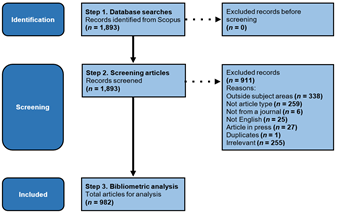
Figure 1 shows that the study identified 1,893 records from the Scopus database. Using some key features of PRISMA guidelines (Page et al., 2021) in screening documents, a total of 911 records (48.1%) were excluded due to being outside the subject area (51.5% of exclusions), not being the correct article type (39.5%), or other minor factors such as language (3.8%), articles in press (4.1%), duplicates (0.2%), and irrelevant (13.5%). Lastly, 982 articles (51.9%) were available for analysis.
Figure 1: The bibliometric review process
Source: Authors’ elaboration of the PRISMA framework
The review employs performance analysis and science mapping to chart the field of hotel finance research using bibliometric tools such as Bibliometrix (Aria & Cuccurullo, 2017) of R-package (RStudio Team, 2024) and VOSviewer version 1.6.20 (Van Eck & Waltman, 2024). Annual publications and average citations identify growth surges and the field’s main outlets and authors. Influence is measured with h-, g-, and m-indices to distinguish sustained impact (h), highly cited peaks (g), and career-stage normalization (m). The h-index reflects steady, broad-based impact across multiple papers (Hirsch, 2005), whereas the g-index gives extra weight to profiles driven by a few highly cited works (Egghe, 2006). Only top authors are measured by the m-index, which normalizes career length and makes it possible to compare scholars at different stages of their careers more fairly (Hirsch, 2005). Meanwhile, conceptual mapping, which utilizes authors’ keywords, includes a thematic map, trend topics, and thematic evolution to identify how these themes emerge, expand, and reconfigure over time.
Author keywords from the co-word analysis were mapped to a predefined hotel-finance dictionary. The match produced the dataset’s most commonly used metrics and methods. Dominant theoretical frameworks were determined via co-citation analysis in VOSviewer: cited references were exported, mapped to a predetermined list of relevant theories, and tabulated to produce frequency counts of the leading frameworks. Without necessitating a thorough systematic review of the entire dataset, a targeted narrative synthesis of the ten most recent articles was used to identify research gaps and future directions.
4. Results
4.1. Key themes and emerging trends in the literature on hotel financial performance measurement
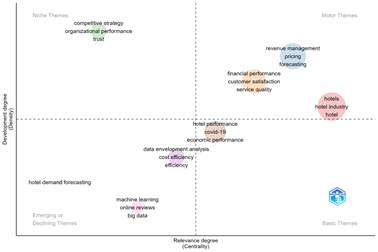
The upper-right quadrant presents themes such as revenue management, pricing, and forecasting, clustered with financial performance and service quality (see Figure 2). This grouping indicates that current work directly links pricing and forecasting to outcomes such as ADR/RevPAR and GOP. At the same time, efficiency-oriented analytics (data envelopment analysis, cost/efficiency, and economic performance) and COVID-19 occupy a transitional zone near the centre, feeding into performance work without yet being dominant.
Figure 2: Thematic map
Source: Scopus data analysed using Bibliometrix
On the margins, mature but field-specific topics (competitive strategy, organizational performance, and trust) act as “niche themes”, whereas hotel demand forecasting, machine learning, online reviews, and big data fall in the “emerging/declining” quadrant – suggesting growing but still under-integrated, data-driven lines that could become the next wave of revenue and profitability research.
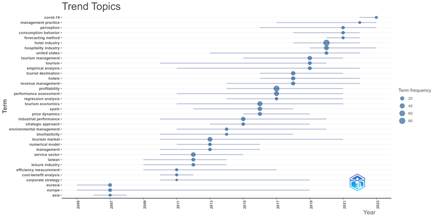
The trend-topics timeline in Figure 3 indicates that hotel-finance research evolved from early cost–efficiency and regional lenses (e.g., efficiency measurement, cost-benefit analysis, corporate strategy, and geographic tags such as Asia/Europe) in the mid-2000s toward operational and market themes in the 2010s (tourism market, numerical model, stochasticity, industrial performance, and price dynamics). After 2016, the largest bubbles are revenue management, profitability, and regression analysis (peaking around 2017–2019), indicating a pivot from descriptive topics to pricing and results that drive ADR/RevPAR and GOP. Since 2019, new bursts – encompassing forecasting methods, management practices, perception/consumption behaviour, and COVID-19 – have pushed the literature toward forecasting-led decisions under demand shocks, with implications for ADR/RevPAR and GOP.
Figure 3: Trend analysis
Source: Scopus data analysed using Bibliometrix
4.2. Most commonly used financial metrics and analytical and methodological approaches to financial performance
RevPAR, ADR, and occupancy indicators lead the top hotel financial metrics, followed by profit efficiency metrics, such as GOPPAR, NOI, and flow-through (see Table 1). Competitive price sensitivity (RGI, elasticity, RevPAR index) closes the list. On the other hand, dynamic pricing tops the list among the analytical and methodological approaches to financial performance, directly targeting RevPAR/ADR. It is followed by panel-data regression for driver identification and benchmarking, as well as efficiency frontiers (DEA/SFA) for operational productivity. Meanwhile, SEM/PLS-SEM capture latent service constructs that feed financials, and machine-learning forecasts support near-term demand and rate decisions. Meanwhile, hedonic and conjoint models quantify willingness-to-pay, the balanced scorecard anchors a multi-KPI strategy, and trend/seasonality decomposition provides the forecasting baseline.
Table 1: Most common hotel financial metrics and analytical and methodological approaches to financial performance
|
Rank |
Hotel financial metrics |
Rank |
Analytical and methodological approaches to financial performance |
|
1 |
Revenue per available room (RevPAR) |
1 |
Dynamic pricing |
|
2 |
Average daily rate (ADR) |
2 |
Panel-data regression |
|
3 |
Occupancy rate |
3 |
Data envelopment analysis |
|
4 |
Gross operating profit per available room (GOPPAR) |
4 |
Structural equation modelling (SEM)/partial least square (PLS)-SEM |
|
5 |
Net operating income (NOI) |
5 |
Machine learning forecasts |
|
6 |
Flow-through |
6 |
Stochastic frontier analysis |
|
7 |
Gross operating profit (GOP) |
7 |
Balanced scorecard and benchmarking |
|
8 |
Revenue generation index (RGI) |
8 |
Hedonic pricing |
|
9 |
Price elasticity of demand |
9 |
Conjoint/choice modelling |
|
10 |
RevPAR index |
10 |
Trend and seasonality decomposition |
Source: Authors’ research
4.3. Most influential authors and journals
Zvi Schwartz is the most productive researcher in this field, with 33 publications and the highest h- and g-indices of 16 and 25, respectively (see Table 2). Ming-Hsiang Chen follows with a g-index of 12 and 12 articles. Following closely is Anna Mattila with 615 citations and an h-index of 9. Seoki Lee ranks fourth with 1,428 citations, making him the most cited author. Other key authors who have made contributions to this field include Chih-Chien Chen, Rob Law, Sheryl Kimes, Mehmet Altin, Rubén Lado-Sestayo, and Enrique Claver-Cortés.
Table 2: Most influential authors
|
Rank |
Author |
h-index |
g-index |
m-index |
TC |
Articles |
|
1 |
Zvi Schwartz |
16 |
25 |
0.696 |
664 |
33 |
|
2 |
Ming-Hsiang Chen |
9 |
12 |
0.563 |
558 |
12 |
|
3 |
Anna Mattila |
9 |
11 |
0.429 |
615 |
11 |
|
4 |
Seoki Lee |
8 |
11 |
0.4 |
1428 |
11 |
|
5 |
Chih-Chien Chen |
8 |
10 |
0.4 |
215 |
10 |
|
6 |
Rob Law |
7 |
10 |
0.333 |
215 |
10 |
|
7 |
Sheryl Kimes |
7 |
9 |
0.28 |
576 |
9 |
|
8 |
Mehmet Altin |
7 |
8 |
0.7 |
161 |
8 |
|
9 |
Rubén Lado-Sestayo |
7 |
7 |
0.7 |
204 |
7 |
|
10 |
Enrique Claver-Cortés |
7 |
7 |
0.368 |
359 |
7 |
TC = Total citations
Source: Scopus data analysed using Bibliometrix
Meanwhile, the International Journal of Hospitality Management stands out as the leading journal in this research area (see Table 3). It scores 48 on the h-index scale, 81 on the g-index scale, and has a total of 7,124 citations. The International Journal of Contemporary Hospitality Management garnered the second most popular journal. It has an h-index of 30, a g-index of 52, and a total citation count of 2,952. Tourism Management is the third most popular journal, with a total citation number of 3,189 and an h-index of 34. Other notable journals in this field also include the Cornell Hospitality Quarterly, Journal of Hospitality and Tourism Research, Tourism Economics, Cornell Hotel and Restaurant Administration Quarterly, Journal of Revenue and Pricing Management, Journal of Business Research, and Sustainability (Switzerland).
Table 3: Most impactful journals
|
Rank |
Source |
h-index |
g-index |
TC |
|
1 |
International Journal of Hospitality Management |
48 |
81 |
7,124 |
|
2 |
International Journal of Contemporary Hospitality Management |
30 |
52 |
2,952 |
|
3 |
Tourism Management |
22 |
34 |
3,189 |
|
4 |
Cornell Hospitality Quarterly |
18 |
34 |
1,210 |
|
5 |
Journal of Hospitality and Tourism Research |
18 |
30 |
924 |
|
6 |
Tourism Economics |
17 |
27 |
884 |
|
7 |
Cornell Hotel and Restaurant Administration Quarterly |
15 |
24 |
861 |
|
8 |
Journal of Revenue and Pricing Management |
13 |
26 |
755 |
|
9 |
Journal of Business Research |
12 |
15 |
774 |
|
10 |
Sustainability (Switzerland) |
11 |
16 |
325 |
TC = Total citations
Source: Scopus data analysed using Bibliometrix
4.4. Evolution of research on hotel financial performance
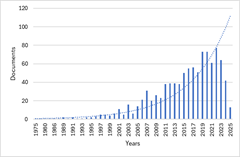
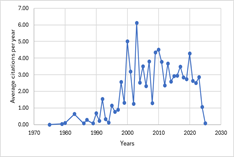
Annual publications on hotel financial performance rose slowly until the late 2000s, then accelerated sharply through the 2010s, peaking around 2018–2021 at roughly 70–80 papers per year (See Figure 4). Output dips from 2022 to 2025. On the other hand, the highest average yearly citation was achieved between 2000 and 2010. Moreover, the figure shows that average yearly citations were quite low between the mid-1970s and the mid-1980s. Abruptly, a very strong spike happened in the 1990s and peaked in the early 2000s. From this peak, citation averages move up and down but mostly remain at a higher level than during previous decades.
Figure 4: Annual scientific productions (a) and average citations per year (b)
|
|
|
|
(a) |
(b) |
Source: Authors’ elaboration
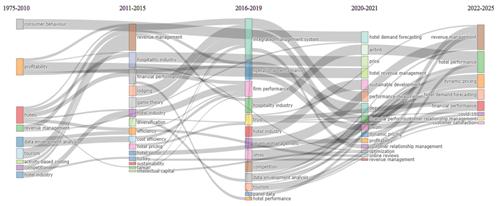
From 1975 to 2010, the field was anchored by consumer behaviour, profitability, hotels, and early revenue management. From 2011 to 2015, it centred on revenue management within the hospitality industry and managerial/performance themes. From 2016 to 2019, it shifted its focus toward management/control/performance measurement, as well as firm performance. In 2020–2021, pandemic-era work concentrates on hotel demand forecasting, ADR, hotel revenue management, and the rise of Airbnb. From 2022 to 2025, the stream consolidates around revenue management, hotel performance, dynamic pricing, demand forecasting, financial performance, and persistent COVID-19 threats – showing a shift to predicting- and pricing-intensive performance research.
Figure 5: Thematic evolution of global research on hotel financial performance
Source: Scopus data analysed using Bibliometrix
4.5. Dominant theoretical frameworks
Table 4 presents the dominant theories used in the literature. The resource-based view (Barney, 1991; Wernerfelt, 1984) tops in the list and argues that hotels with distinctive, hard-to-imitate assets – such as brand strength, prime location, superior RMS/CRM know-how, and a service-centric culture – convert those advantages into higher RevPAR, stronger GOPPAR, and healthier margins. Agency theory (Fama, 1980; Jensen & Meckling, 1976) follows the list and explains how aligning incentives across owners, operators, and franchisees reduces agency costs and profit volatility, thereby improving the GOP and ROA/ROE. Market orientation (Kohli & Jaworski, 1990; Narver & Slater, 1990) ranks third and closes the loop on demand by continuously sensing guest needs and competitor moves, and responding with targeted offerings and pricing. Market-oriented hotels raise willingness-to-pay and capture demand, driving ADR, occupancy, and RevPAR growth. Other theories that support the research landscape also include the service-profit chain (Heskett et al., 1994), yield management (Belobaba, 1989; Littlewood, 1972), prospect theory (Kahneman & Tversky, 1979), capital structure (Modigliani & Miller, 1963; Myers & Majluf, 1984), transaction cost economics (Coase, 1937; Williamson, 1981), dynamic capabilities (Teece et al., 1997), and the natural resource-based view (Hart, 1995; Hart & Dowell, 2011).
Table 4: Dominant theories and frameworks in this field
|
Rank |
Theory/framework |
Key proponents |
Implications for hotel financial metrics |
|
1 |
Resource-based view |
Ties unique assets (brand, location, RMS) to superior RevPAR and GOPPAR |
|
|
2 |
Agency theory |
Owner–operator/franchise incentives shape GOP |
|
|
3 |
Market orientation |
Demand sensing improves pricing and mix |
|
|
4 |
Service-profit chain |
Employee engagement and service quality drive guest satisfaction and loyalty, which translate into higher revenue (RevPAR) and profitability (GOPPAR). |
|
|
5 |
Yield management |
Core driver of RevPAR via protection levels/bid prices |
|
|
6 |
Prospect theory |
Framing/fees/reference prices affect conversion & RevPAR |
|
|
7 |
Capital structure |
Financing preferences shape investment paths and financial performance |
|
|
8 |
Transaction cost economics |
Governance/contracting choices impact costs and margins |
|
|
9 |
Dynamic capabilities |
Explains financial performance gains from fast pricing/channel pivots |
|
|
10 |
Natural resource-based view |
Eco-capabilities cut cost, can lift ADR |
Source: Authors’ research
4.6. Major research gaps and future directions in hotel financial performance measurement
Table 5 presents the persistent gaps extracted from the 10 most recent articles in the dataset. The poor external validity of research on hotel financial performance is caused by several factors, including the lack of detailed data and common standards, the over-reliance on simple ratio analysis, the ambiguity of revenue management roles (especially in small or independent hotels), the underutilization of sophisticated demand/price forecasting, and organizational barriers to putting strong metrics into practice. Important questions still surround the profitability and loyalty impacts of hidden offers, the role of reputation in pricing power and demand elasticity, the impact of governance and entrepreneurial orientation, the relationship between ESG and performance, and the sparse empirical testing of novel theories in hospitality settings.
Table 5: Major research gaps extracted from the 10 most recent articles
|
Research gaps |
Illustrative sources |
|
Limited access to detailed hotel data (ADR, occupancy, RevPAR, costs) and high dependence on secondary data. |
|
|
No shared standards or benchmarks for hotel financial performance metrics |
|
|
Heavy reliance on generic ratio analysis in evaluating hotel financial performance |
|
|
Unclear roles and reporting lines for revenue management in independents and small hotels |
|
|
Underutilization of advanced techniques and applications for demand and price forecasting |
|
|
Uncertain impact of hidden offers on the hotel’s profitability and customer loyalty |
|
|
Organizational enablers and barriers to metric adoption |
|
|
Lack of external validity and generalizability |
Magnini et al. (2025); Peco-Torres et al. (2025); Rojas and Jatowt (2025); Sun et al. (2025) |
|
Underexplored influence of governance and entrepreneurship orientation on the performance of hospitality enterprises |
|
|
Unclear link between ESG and hotel performance metrics |
|
|
The role of reputation on the price power and demand elasticity of hotels |
|
|
Lack of empirical testing of new theories and constructs in hospitality contexts |
Source: Authors’ research
Meanwhile, Table 6 outlines the future directions extracted from the 10 most recent articles in the dataset. Future work should test whether flow-through (especially with PMS/RMS analytics and AI forecasting that uses web/holiday/weather data) outperforms traditional ratios, identify which RM structures and automation choices lift ADR/RevPAR/GOPPAR (and where), quantify the profitability and loyalty effects of opaque deals, pinpoint organizational drivers of NRevPAR/RevPAC adoption, verify generalizability across markets and ownership forms, and examine how board traits/entrepreneurial orientation, property-level ESG, and online reputation shape pricing power, demand elasticity, and firm outcomes.
Table 6: Future research directions synthesized from the 10 most recent articles
|
Future research questions |
Illustrative sources |
|
How does flow-through change over time and across lodging vs. F&B, and does it beat traditional ratios at predicting GOPPAR? |
|
|
Do PMS/RMS integrations and analytics make flow-through more accurate and useful than manual methods? |
|
|
How do different RM structures (to GM, under Sales/Marketing, or none) affect ADR/RevPAR/GOPPAR, and when? |
|
|
When do AI-enabled RMS pay off in SMEs/independents, and which RM tasks should be automated vs. human-led? |
|
|
Do probabilistic/transformer forecasts with web, holiday, and weather data improve decisions and financial KPIs vs. point forecasts? |
|
|
How do opaque deals impact profit, channel cannibalization, guest mix, and loyalty, and what drives these effects? |
|
|
Which organizational factors best predict NRevPAR/RevPAC adoption and its impact on market share and GOPPAR? |
|
|
Do results on RM structure, forecasting, and metric adoption generalize across countries, ownership types, and chains vs. independents? |
Magnini et al. (2025); Peco-Torres et al. (2025); Rojas and Jatowt (2025); Sun et al. (2025) |
|
How do board traits and entrepreneurial orientation shape financial performance, and through which RM/innovation channels? |
|
|
How do property-level ESG actions and online reputation influence price power, demand elasticity, and firm outcomes? |
Lu et al. (2025); Magnini et al. (2025); Peco-Torres et al. (2025) |
Source: Authors’ research
5. Discussion
A substantial core cluster of works about pricing, forecasting, and revenue management is revealed by a bibliometric analysis of research on hotel financial performance (Calinao et al., 2022; Lentz et al., 2021; Wu et al., 2022). Big data and machine learning have become the focus of attention in the modern era (Farag et al., 2022; Pereira & Cerqueira, 2022). However, because continuously updated profitability metrics are available for benchmarking, incorporating data analytics tools into revenue management can facilitate better mix, pricing, and inventory decisions in volatile environments. Since 2019, a growing trend in the literature has emerged, with both the supply and demand sides making decisions based on forecasts (Heo et al., 2023). As a result of COVID-19, accurate forecasts became the decision-making powerhouse for hotels (Binesh et al., 2024; Zheng et al., 2024), where times that matched pricing and inventory with reliable projections resulted in enhanced ADR and RevPAR and consequently boosted GOP.
Hotels typically measure RevPAR, ADR, occupancy, and GOPPAR to understand revenue efficiency and adjust prices accordingly to demand (Bianco et al., 2023; Widz et al., 2022). Recently, hotels have begun to track net operating income (NOI) alongside RevPAR and ADR, and deploy dynamic pricing that reacts to booking pace and competitor moves – not just seasonality. Ampountolas et al. (2021) detail how revenue managers integrate NOI targets into pricing rules, while Farag (2022) shows the adoption of market-responsive algorithms in competitive urban markets. This change of focus responds to the hospitality industry’s dependency on instant analytics and algorithmic forecasting for revenue management, decision-making to maximize operations, and responding promptly to market movements. Hospitality accounting analysis has also evolved from being opinion-dependent and based on fixed ratios to employing dynamic and predictive models, thereby facilitating better responsiveness, personalization, and sustained profitability in the industry.
Among academic writers who have had a major influence on hotel financial performance studies, Zvi Schwartz and Ming-Hsiang Chen are widely acknowledged as two of the most productive authors with strong citation impacts, due to their pioneering role in revenue management and financial forecasting. These patterns suggest that future scholarship should build on revenue-management and forecasting foundations – for example, by integrating cost-sensitive metrics (e.g., NOI/flow-through) with advanced predictive methods – and seek collaboration or citation linkages with leading author networks to enhance theory refinement and methodological rigor. The International Journal of Hospitality Management and the International Journal of Contemporary Hospitality Management are considered the most influential journals based on bibliometric impact indicators. The result also indicates that these top journals are the most strategic outlets for disseminating hospitality-finance work that bridges research and practice, guiding authors on where to target their submissions and informing practitioners on where to look for evidence-based insights on pricing and financial decision-making.
From 1975 to 2010, scholarship progressed from consumer behaviour and basic profitability toward the foundations of revenue management (O’neill & Mattila, 2007; Schwartz, 2006). In 2011–2015, revenue management was framed within managerial and performance perspectives (Bilgihan et al., 2014), and in 2016–2019 period, the focus shifted inside the firm – strengthening management control and KPIs (RevPAR, ADR, GOPPAR) to connect operations with firm-level outcomes (Kim et al., 2019). ADR resilience, short-horizon demand forecasting, and Airbnb’s competitive pressures were given top priority during the pandemic years (Ampountolas, 2019; Gibbs et al., 2018). Predictive demand modelling and dynamic pricing have been the focus of the field since 2022, while still considering COVID-related uncertainty (Anguera-Torrell & Nicolau, 2025). The literature clearly moves beyond descriptive metrics toward an optimization-driven, profit-centric approach that integrates forecasting and pricing with cost-to-serve, channel mix, and risk-adjusted flow-through to support stronger financial decision-making.
The literature has also leaned heavily on a small set of dominant lenses – resource-based view, agency theory, market orientation, revenue/yield management, transaction cost economics, capital structure, dynamic capabilities, and the (natural) RBV. These frameworks provide powerful explanations of capability building, governance, pricing, and risk (Franco et al., 2020; Salama, 2021). However, their repeated use risks conceptual path dependence, keeping inquiry anchored to revenue and control logics. By contrast, behavioural and social perspectives – such as social identity theory, and social learning – remain underused. Broadening the toolkit would enrich explanations of how pricing norms diffuse, how frontline culture shapes compliance with RMS policies, and how guests’ reference prices and identities drive mix and margin – allowing our study to link capability and governance choices with psychologically realistic demand responses and, ultimately, profit-centric KPIs.
Due to the scarcity of firm-level data and the lack of harmonized metrics, studies still tend to rely on RevPAR and ADR rather than on profit-oriented indicators such as net profit margin or CPAR (Boo et al., 2025; Toker, 2025). The impact of opaque offers on profit and loyalty also remains unclear (Zhao et al., 2025). Moreover, links among pricing power, demand elasticity, and firm outcomes – and their interplay with governance, entrepreneurial orientation, ESG practices, and online reputation – are underexplored and lack external validity (Anguera-Torrell & Nicolau, 2025; Lu et al., 2025; Lun et al., 2025; Magnini et al., 2025; Peco-Torres et al., 2025).
6. Conclusion
This bibliometric analysis has mapped the intellectual landscape of measuring hotel financial performance, identifying the dominant themes, leading authors, and methods that influence the field. The literature focuses on pricing, forecasting, and revenue management, with a recent shift toward big data and machine learning, as well as a growing emphasis on profit-oriented practices. RevPAR, ADR, occupancy, and GOPPAR were the dominant financial metrics used in the hotel industry. Most papers also relied on a small set of dominant theories, such as resource-based view, agency theory, market orientation, and yield management. Key gaps persist – scarce firm-level data and uneven metrics keep studies tied to RevPAR/ADR, the effects of opaque offers on profit and loyalty are unclear, and links among pricing power, elasticity, governance, ESG, and reputation lack external validity.
This study advances the hotel financial-performance literature. However, it is limited by the reliance on Scopus, whose English-language bias may have reduced the retrieval of relevant non-English and non-indexed works. Despite the added document-level checks in determining the most commonly used financial metrics and dominant frameworks, the dictionary-based audit of titles, abstracts, keywords, and cited references, rather than full texts, may miss context-specific usage and yield frequency counts that reflect mentions rather than validated operational use of metrics. Moreover, relying on very recent papers may overstate short-term trends. Future work can test newer forecasting methods against profit-based metrics (e.g., GOPPAR, flow-through), examine opaque offers with loyalty status in the model, and use more diverse empirical approaches.
CRediT author statement
Alma Arnejo: Conceptualization, Data curation, Formal analysis, Investigation, Visualization, Writing – original draft, Writing – review & editing. Melvin Sarsale: Conceptualization, Data curation, Formal analysis, Investigation, Methodology, Visualization, Writing – review & editing.
Declaration of generative AI in the writing process
During the preparation of this manuscript, the authors complementarily used Grammarly and ChatGPT to improve the fluency, clarity, and quality of the manuscript. After using the service, the authors reviewed and edited the content as needed and take full responsibility for the content of the published article.
Conflict of interest
The authors declare no conflict of interest.
References
1. Acampora, A., Lucchetti, M. C., Merli, R., & Ali, F. (2022). The theoretical development and research methodology in green hotels research: A systematic literature review. Journal of Hospitality and Tourism Management, 51, 512–528. https://doi.org/10.1016/j.jhtm.2022.05.007
2. Alotaibi, E. (2020). Application of machine learning in the hotel industry: A critical review. Journal of Association of Arab Universities for Tourism and Hospitality, 18(3), 78–96. https://doi.org/10.21608/jaauth.2020.38784.1060
3. Ampountolas, A. (2019). Forecasting hotel demand uncertainty using time series Bayesian VAR models. Tourism Economics, 25(5), 734–756. https://doi.org/10.1177/1354816618801741
4. Ampountolas, A., Shaw, G., & James, S. (2021). Examining the relationships between market indicators and hotel pricing approaches. Tourism Economics, 27(8), 1591–1614. https://doi.org/10.1177/1354816620925225
5. Anguera-Torrell, O., & Nicolau, J. L. (2025). Unveiling customer choice with salience theory: The link between room price and breakfast demand. International Journal of Hospitality Management, 124, 103968. https://doi.org/10.1016/j.ijhm.2024.103968
6. Aria, M., & Cuccurullo, C. (2017). bibliometrix: An R-tool for comprehensive science mapping analysis. Journal of Informetrics, 11(4), 959–975. https://doi.org/10.1016/j.joi.2017.08.007
7. Ashraf, S., Sadiq, M., Ferreira, P., & Almeida, A. M. (2023). Intellectual capital and a firm’s sustainable performance and growth before and during the COVID-19 crisis: A comparative analysis of small and large European hospitality firms. Sustainability, 15(12), 9743. https://doi.org/10.3390/su15129743
8. Barney, J. (1991). Firm resources and sustained competitive advantage. Journal of Management, 17(1), 99–120. https://doi.org/10.1177/014920639101700108
9. Belobaba, P. P. (1989). OR practice-Application of a probabilistic decision model to airline seat inventory control. Operations Research, 37(2), 183–197. https://doi.org/10.1287/opre.37.2.183
10. Bianco, S., Bernard, S., & Singal, M. (2023). The impact of sustainability certifications on performance and competitive action in hotels. International Journal of Hospitality Management, 108, 103379. https://doi.org/10.1016/j.ijhm.2022.103379
11. Bilgihan, A., Okumus, F., Nusair, K., & Bujisic, M. (2014). Online experiences: flow theory, measuring online customer experience in e-commerce and managerial implications for the lodging industry. Information Technology & Tourism, 14(1), 49–71. https://doi.org/10.1007/s40558-013-0003-3
12. Binesh, F., Belarmino, A. M., van der Rest, J. P., Singh, A. K., & Raab, C. (2024). Forecasting hotel room prices when entering turbulent times: a game-theoretic artificial neural network model. International Journal of Contemporary Hospitality Management, 36(4), 1044–1065. https://doi.org/10.1108/IJCHM-10-2022-1233
13. Boo, H. C., Detlev, R. E. M. Y., & Kuan-Huei, L. E. E. (2025). Drivers, barriers, and challenges in NRevPAR and RevPAC adoption-Towards a revenue management adoption scale. International Journal of Hospitality Management, 127, 104116. https://doi.org/10.1016/j.ijhm.2025.104116
14. Calinao, R. J. G., Amores, M. V., Rellores, E. M. A., & Tabla, F. T. G. (2022). The determinants of hotel room price in Philippines: A structural equation modeling analysis. Journal of Applied Structural Equation Modeling, 6(1), 1–30. https://doi.org/10.47263/JASEM.6(1)02
15. Campos, F., Santos, L. L., Gomes, C., & Cardoso, L. (2022). Management accounting practices in the hospitality industry: A systematic review and critical approach. Tourism and Hospitality, 3(1), 243–264. https://doi.org/10.3390/tourhosp3010017
16. Coase, R. H. (1937). The nature of the firm. Economica, 4(16), 386–405. https://doi.org/10.1111/j.1468-0335.1937.tb00002.
17. Denizci Guillet, B., & Mohammed, I. (2015). Revenue management research in hospitality and tourism: A critical review of current literature and suggestions for future research. International Journal of Contemporary Hospitality Management, 27(4), 526–560. https://doi.org/10.1108/IJCHM-06-2014-0295
18. Duric, Z., & Potočnik Topler, J. (2021). The role of performance and environmental sustainability indicators in hotel competitiveness. Sustainability, 13(12), 6574. https://doi.org/10.3390/su13126574
19. Dutta, I. (2024). Adapting to change: Exploring contemporary issues in the tourism and hospitality industry. International Journal of Advanced Academic Studies, 6(9), 1–6. https://doi.org/10.33545/27068919.2024.v6.i9a.1262
20. Egghe, L. (2006). Theory and practise of the g-index. Scientometrics, 69(1), 131–152. https://doi.org/10.1007/s11192-006-0144-7
22. Fama, E. F. (1980). Agency problems and the theory of the firm. Journal of Political Economy, 88(2), 288–307. https://doi.org/10.1086/260866
24. Farag, H. F. I., González Serrano, L., & Talón-Ballestero, P. (2022). Analysing the impact of dynamic open pricing on hotel revenue management. Journal of Tourism Analysis, 29(2), 80–117. https://doi.org/10.53596/jta.v29i2.422
25. Franco, S., Caroli, M. G., Cappa, F., & Del Chiappa, G. (2020). Are you good enough? CSR, quality management and corporate financial performance in the hospitality industry. International Journal of Hospitality Management, 88, 102395. https://doi.org/10.1016/j.ijhm.2019.102395
26. Gibbs, C., Guttentag, D., Gretzel, U., Yao, L., & Morton, J. (2018). Use of dynamic pricing strategies by Airbnb hosts. International Journal of Contemporary Hospitality Management, 30(1), 2–20. https://doi.org/10.1108/IJCHM-09-2016-0540
27. Gibraltar, M. R., Hermanto, H., & Bandono, B. (2024). Analyzing financial performance of resort and hotel subsector: A case study at Saung Dolken. Indonesian Journal of Multidisciplinary Science, 3(4). https://doi.org/10.55324/ijoms.v3i4.810
28. Gonçalves, B., Coelho, L. S., & Pinto, P. S. (2024). Earnings management in the hospitality industry: A systematic literature review. Tourism & Management Studies, 20(1), 65–77. https://doi.org/10.18089/tms.20240105
29. Gunduz Songur, A., Turktarhan, G., & Cobanoglu, C. (2023). Progress on green technology research in hotels: A literature review. Journal of Hospitality and Tourism Insights, 6(5), 2052–2072. https://doi.org/10.1108/JHTI-10-2021-0280
30. Hart, S. L. (1995). A natural-resource-based view of the firm. Academy of Management Review, 20(4), 986–1014. https://doi.org/10.5465/amr.1995.9512280033
31. Hart, S. L., & Dowell, G. (2011). Invited editorial: A natural-resource-based view of the firm: Fifteen years after. Journal of Management, 37(5), 1464–1479. https://doi.org/10.1177/0149206310390219
32. Heo, C. Y., Viverit, L., & Pereira, L. N. (2023). Does historical data still matter for demand forecasting in uncertain and turbulent times? An extension of the additive pickup time series method for SME hotels. Journal of Revenue and Pricing Management. https://doi.org/10.1057/s41272-023-00421-1
33. Herath, R. B., Tham, J., Khatibi, A., & Azam, S. F. A. (2023). An investigation into the relationship between revenue management practices and financial performance in star-rated hotels in Sri Lanka. Journal of Law and Sustainable Development, 11(11), e1538. https://doi.org/10.55908/sdgs.v11i11.1538
34. Heskett, J. L., Jones, T. O., Loveman, G. W., Sasser, W. E., Jr., & Schlesinger, L. A. (1994). Putting the service-profit chain to work. Harvard Business Review, 72(2), 164–170.
35. Hirsch, J. E. (2005). An index to quantify an individual’s scientific research output. Proceedings of the National Academy of Sciences of the United States of America, 102(46), 16569–16572. https://doi.org/10.1073/pnas.0507655102
36. Iranmanesh, M., Ghobakhloo, M., Nilashi, M., Tseng, M. L., Yadegaridehkordi, E., & Leung, N. (2022). Applications of disruptive digital technologies in hotel industry: A systematic review. International Journal of Hospitality Management, 107, 103304. https://doi.org/10.1016/j.ijhm.2022.103304
38. Jensen, M. C., & Meckling, W. H. (1976). Theory of the firm: Managerial behavior, agency costs and ownership structure. Journal of Financial Economics, 3(4), 305–360. https://doi.org/10.1016/0304-405X(76)90026-X
39. Kahneman, D., & Tversky, A. (1979). Prospect theory: An analysis of decision under risk. Econometrica, 47(2), 263–292. https://doi.org/10.2307/1914185
40. Kim, M., Roehl, W., & Lee, S. K. (2019). Effect of hotels’ price discounts on performance recovery after a crisis. International Journal of Hospitality Management, 83, 74–82. https://doi.org/10.1016/j.ijhm.2019.04.006
41. Kohli, A. K., & Jaworski, B. J. (1990). Market orientation: The construct, research propositions, and managerial implications. Journal of Marketing, 54(2), 1–18. https://doi.org/10.1177/002224299005400201
42. Lentz, M., Berezan, O., & Raab, C. (2021). Uncovering the relationship between revenue management and hotel loyalty programs. Journal of Revenue and Pricing Management, 21(3), 306. https://doi.org/10.1057/s41272-021-00331-0
43. Lin, M. S., Shin, H. H., & Shin, S. (2024). The economic impacts of information and communication technologies in the tourism and hospitality industry: A systematic review of the literature. Tourism Economics, 31(2), 165–182. https://doi.org/10.1177/13548166241253309
45. Lu, K., Onuk, C. B., Xia, Y., & Zhang, J. (2025). ESG ratings and financial performance in the global hospitality industry. Journal of Risk and Financial Management, 18(1), 24. https://doi.org/10.3390/jrfm18010024
46. Lun, P., Cheong, C. S., Hallak, R., Mihaylov, G., & Zurbruegg, R. (2025). Entrepreneurial orientation, board tenure and the financial performance of hospitality firms. International Journal of Hospitality Management, 126, 104002. https://doi.org/10.1016/j.ijhm.2024.104002
47. Lyu, C., Wang, M., Zhang, R., & Ng, Y. N. (2021). Corporate social responsibility and financial performance in hospitality industry: A critical review. Proceedings of the 7th International Conference on Social Science and Higher Education (ICSSHE 2021) (pp. 135–139). Atlantis Press. https://doi.org/10.2991/assehr.k.211122.072
48. Magnini, V. P., Rumbaugh, E. G., Quendler, E., & Boley, B. B. (2025). State of Incentivizing property-level environmental sustainability in the US hotel industry. International Journal of Hospitality Management, 126, 104109. https://doi.org/10.1016/j.ijhm.2025.104109
49. Milton, T. (2024). Exploring the synergy of artificial intelligence and financial management in the hotel industry: A critical review of innovations, challenges, and strategic implications for enhancing operational efficiency and competitive advantage. International Journal for Multidimensional Research Perspectives, 2(2), 79–95.
51. Mitrović, M., Janković, S., & Ivankovič, G. (2016). Hotel performance measurement: Literature review. SITCON 2016-Singidunum International Tourism Conference (pp. 250–257). Singidunum University. https://doi.org/10.15308/Sitcon-2016-250-257
53. Myers, S. C., & Majluf, N. S. (1984). Corporate Financing and investment decisions when firms have information that investors do not have. Journal of Financial Economics, 13, 187–221. https://doi.org/10.1016/0304-405X(84)90023-0
54. Narver, J. C., & Slater, S. F. (1990). The effect of a market orientation on business profitability. Journal of Marketing, 54(4), 20–35. https://doi.org/10.1177/002224299005400403
55. Nguyen, T. T. C., Le, A. T. H., & Nguyen, C. V. (2023). Internal factors affecting the financial performance of an organisation’s business processes. Business Process Management Journal, 29(5), 1408–1435. https://doi.org/10.1108/BPMJ-10-2022-0486
56. Nurwitasari, A., Waspada, I., & Sari, M. (2023). Comparison of tourism and hospitality industry financial performance before and after COVID-19: A systematic literature review. NHI Hospitality International Journal, 1(2), 64–74. https://doi.org/10.34013/nhij.v1i2.950
57. O’neill, J. W., & Mattila, A. S. (2007). The debate regarding profitability: Hotel unit and hotel brand revenue and profit relationships. Journal of Travel & Tourism Marketing, 21(2-3), 131–135. https://doi.org/10.1300/J073v21n02_10
58. Olorunsola, V. O., Saydam, M. B., Arici, H. E., & Köseoglu, M. A. (2024). The predictive roles of financial indicators and governance scores on firms’ emission performance in the tourism and hospitality industry. Tourism Economics, 30(6), 1382–1403. https://doi.org/10.1177/13548166231207132
59. Ozdemir, O., Dogru, T., Kizildag, M., Mody, M., & Suess, C. (2021). Quantifying the economic impact of COVID-19 on the US hotel industry: Examination of hotel segments and operational structures. Tourism Management Perspectives, 39, 100864. https://doi.org/10.1016/j.tmp.2021.100864
60. Page, M. J., McKenzie, J. E., Bossuyt, P. M., Boutron, I., Hoffmann, T. C., Mulrow, C. D., … & Brennan, S. E. (2021). The PRISMA 2020 statement: An updated guideline for reporting systematic reviews. International Journal of Surgery, 88, 105906. https://doi.org/10.1016/j.ijsu.2021.105906
61. Peco-Torres, F., Polo-Peña, A. I., & Frías-Jamilena, D. M. (2025). How to enhance online reputation? An empirical study from a joint customer-firm perspective. Journal of Vacation Marketing, 31(1), 67–82. https://doi.org/10.1177/13567667231183480
62. Pereira, L. N., & Cerqueira, V. (2022). Forecasting hotel demand for revenue management using machine learning regression methods. Current Issues in Tourism, 25(17), 2733–2750. https://doi.org/10.1080/13683500.2021.1999397
63. Pons, S. T., Noone, B., & Johns, M. (2025). Integrated revenue strategy for the Park Hotel: A data-driven approach to strategy development and evaluation. Journal of Hospitality & Tourism Cases, 13(1), 29–44. https://doi.org/10.1177/21649987231221476
65. Rojas, C., & Jatowt, A. (2025). Transformer-based probabilistic forecasting of daily hotel demand using web search behavior. Knowledge-Based Systems, 310, 112966. https://doi.org/10.1016/j.knosys.2025.112966
67. Salama, W. M. E. (2021). Impact of management by objectives in enhancing sustainable organisational performance in hotels. African Journal of Hospitality, Tourism and Leisure, 10(3), 805–520. https://doi.org/10.46222/ajhtl.19770720-133
68. Santoso, T. G., & Supatmi, S. (2021). Financial ratio analysis to assess financial performance of the hotel industry. International Journal of Social Science and Business, 5(3), 346–353. https://doi.org/10.23887/ijssb.v5i3.37003
69. Schwartz, Z. (2006). Advanced booking and revenue management: Room rates and the consumers’ strategic zones. International Journal of Hospitality Management, 25(3), 447–462. https://doi.org/10.1016/j.ijhm.2005.02.002
70. Sharma, A., Shin, H., Santa-María, M. J., & Nicolau, J. L. (2021). Hotels’ COVID-19 innovation and performance. Annals of Tourism Research, 88, 103180. https://doi.org/10.1016/j.annals.2021.103180
71. Subying, C., & Yoopetch, C. (2023). A bibliometric review of revenue management in the tourism and hospitality industry, 1989-2021. Sustainability, 15(20), 15089. https://doi.org/10.3390/su152015089
72. Sun, L., Schuckert, M., & Hon, A. H. (2025). Enhancing organizational structures for revenue management in small and medium-sized independent hotels: Evidence from China. International Journal of Hospitality Management, 127, 104122. https://doi.org/10.1016/j.ijhm.2025.104122
73. Tarí, J. J., Molina-Azorín, J. F., Pereira-Moliner, J., López-Gamero, M. D., & Pertusa-Ortega, E. M. (2014). Quality management and performance in the hotel industry: A literature review. In M. Peris-Ortiz & J. Álvarez-García (Eds.), Action-based quality management (pp. 1–27). Springer. https://doi.org/10.1007/978-3-319-06453-6_1
74. Teece, D. J., Pisano, G., & Shuen, A. (1997). Dynamic capabilities and strategic management. Strategic Management Journal, 18(7), 509–533. https://doi.org/10.1002/(SICI)1097-0266(199708)18:73.0.CO;2-Z
75. Toker, T. (2025). The operating profit flow method as a profitability analysis tool for hospitality enterprises. International Journal of Hospitality Management, 125, 103997. https://doi.org/10.1016/j.ijhm.2024.103997
77. Vidali, M. E., Menegaki, A. N., & Ahmad, N. (2024). Parametric and non‐parametric measurement of efficiency in hotel industry: A systematic literature review. Journal of Economic Surveys. https://doi.org/10.1111/joes.12653
78. Vives, A., Jacob, M., & Payeras, M. (2018). Revenue management and price optimization techniques in the hotel sector: A critical literature review. Tourism Economics, 24(6), 720–752. https://doi.org/10.1177/1354816618777590
79. Wernerfelt, B. (1984). A resource-based view of the firm. Strategic Management Journal, 5(2), 171–180. https://doi.org/10.1002/smj.4250050207
80. Widz, M., Krukowska, R., Walas, B., & Kruczek, Z. (2022). Course of values of key performance indicators in city hotels during the COVID-19 pandemic: Poland case study. Sustainability, 14(19), 12454. https://doi.org/10.3390/su141912454
81. Williamson, O. E. (1981). The economics of organization: The transaction cost approach. American Journal of Sociology, 87(3), 548–577. https://doi.org/10.1086/227496
82. WTTC. (2023). Economic impact report 2023. World Travel & Tourism Council.
83. Wu, D. C., Zhong, S., Qiu, R. T., & Wu, J. (2022). Are customer reviews just reviews? Hotel forecasting using sentiment analysis. Tourism Economics, 28(3), 795–816. https://doi.org/10.1177/13548166211049865
84. Yoopetch, C., & Chareanporn, T. (2024). Measuring hotel financial and non-financial performance in Thailand: The application of technology-organization-environment (TOE) framework. Journal of Ecohumanism, 3(6), 1703–1718. https://doi.org/10.62754/joe.v3i6.4130
85. Zhao, Z., Fu, C., Chen, M. H., & Yang, Y. (2025). Curiosity and hotel revenue management challenges: Dynamics of opaque and low-end products. Annals of Tourism Research, 111, 103895. https://doi.org/10.1016/j.annals.2025.103895
86. Zheng, W., Li, C., & Deng, Z. (2024). Hotel demand forecasting with multi-scale spatiotemporal features. International Journal of Hospitality Management, 123, 103895. https://doi.org/10.1016/j.ijhm.2024.103895
